Chin wing osteotomy trong điều trị bất đối xứng xương hàm dướiChin wing osteotomy for complex mandibular asymmetry
02/09/2026Kết quảResults
Trong phẫu thuật chỉnh hình xương hàm, đưa hai cung răng về đúng tương quan không phải lúc nào cũng đồng nghĩa với việc khuôn mặt sẽ trở nên cân đối.
Điều này đặc biệt rõ ở những bệnh nhân mà hình dạng bờ dưới xương hàm không tương ứng với vị trí của cung răng. Sau khi hàm trên và hàm dưới đã được đưa về vị trí phù hợp, đường viền xương hàm và cằm vẫn có thể bất đối xứng rõ rệt.
Chin Wing osteotomy là một kỹ thuật cho phép giải quyết riêng thành phần này của biến dạng.
Khi khớp cắn và đường viền xương hàm là hai vấn đề khác nhau
Các kỹ thuật chỉnh hình xương hàm thông thường như Le Fort I và BSSO chủ yếu cho phép thay đổi vị trí của hàm trên và hàm dưới để điều chỉnh tương quan xương, khớp cắn và khuôn mặt.
Tạo hình cằm thông thường có thể điều chỉnh vị trí và hình dạng vùng cằm.
Tuy nhiên, giữa cằm và góc hàm còn tồn tại một cấu trúc thẩm mỹ rất quan trọng: toàn bộ bờ dưới của thân xương hàm dưới.
Ở một số bệnh nhân bất đối xứng phức tạp, vấn đề không chỉ nằm ở vị trí của hàm dưới mà còn ở chính hình dạng, chiều cao và đường cong của bờ nền xương hàm hai bên.
Chin Wing cho phép tách một dải xương dài chạy từ vùng cằm về phía góc hàm. Sau khi được giải phóng, phân đoạn này có thể được di chuyển và định vị tương đối độc lập với phần xương hàm mang răng phía trên.
Nhờ đó, phẫu thuật viên có thể kiểm soát đường viền cằm – bờ hàm – góc hàm như một đơn vị thẩm mỹ riêng, trong khi vị trí cung răng và khớp cắn được xử lý bằng các kỹ thuật chỉnh hình xương hàm khác.
Một trường hợp bất đối xứng phức tạp kết hợp sai khớp cắn loại III
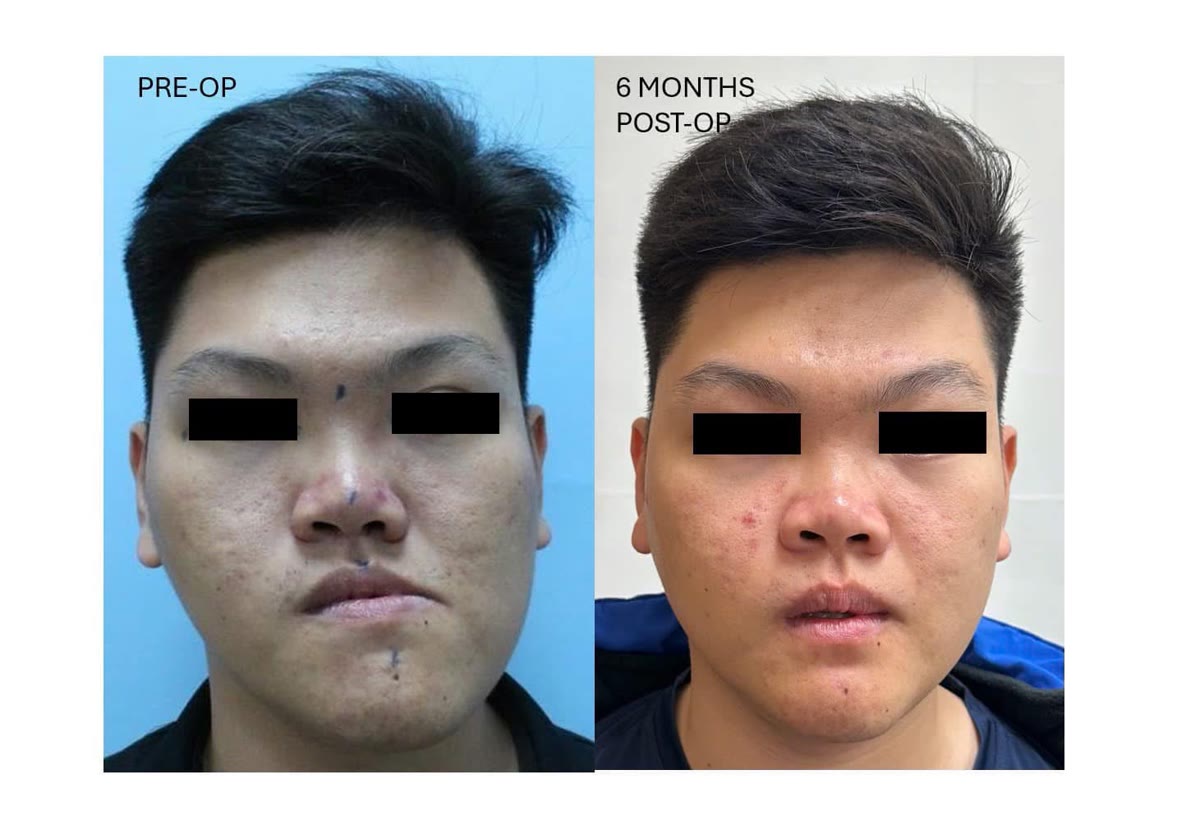
Bệnh nhân trong trường hợp này có bất thường đồng thời về hình dạng, vị trí và kích thước của hai nửa xương hàm dưới.
Bên cạnh bất đối xứng, xương hàm dưới còn quá phát đáng kể, tạo nên sai khớp cắn loại III do xương rõ rệt.
Hàm trên cũng có bất thường về hình dạng cung răng và tương quan theo chiều ngang.
Nếu chỉ sử dụng Le Fort I và BSSO, hai cung răng có thể được đưa về tương quan phù hợp, nhưng sự khác biệt giữa bờ dưới xương hàm hai bên vẫn sẽ còn rõ.
Nói cách khác, khớp cắn có thể được điều chỉnh nhưng đường viền khuôn mặt vẫn chưa được giải quyết đầy đủ.
Đây là lý do Chin Wing được đưa vào kế hoạch phẫu thuật.
Ba bài toán được giải quyết trong cùng một kế hoạch
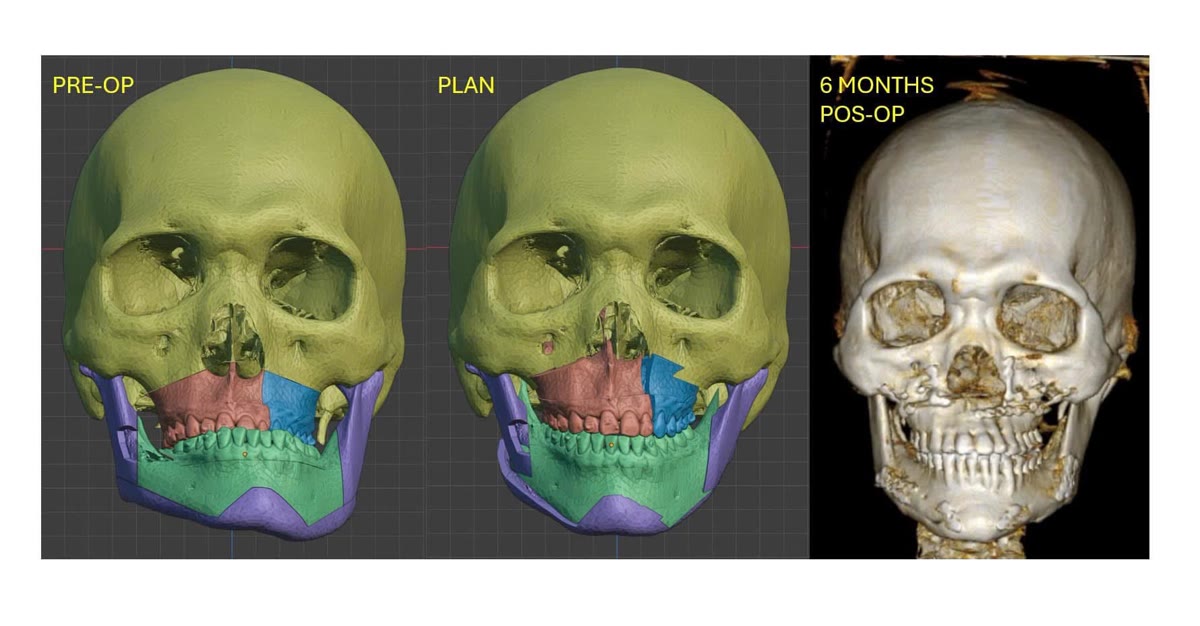
Phương án điều trị được xây dựng với ba thành phần chính.
Chin Wing osteotomy được thực hiện để điều chỉnh riêng bờ dưới xương hàm, cải thiện sự cân đối giữa hai bên và tái tạo đường viền tầng mặt dưới.
BSSO hai bên được thực hiện để đưa hàm dưới ra sau, điều chỉnh tình trạng quá phát hàm dưới và tương quan xương loại III.
Ở hàm trên, Le Fort I được thực hiện kết hợp chia hàm trên thành hai phân đoạn. Điều này cho phép vừa đưa hàm trên ra trước, vừa điều chỉnh hình dạng và tương quan theo chiều ngang của cung răng, đồng thời kiểm soát mặt phẳng cắn nhằm hạn chế tình trạng cắn chéo sau phẫu thuật.
Như vậy, mỗi kỹ thuật đảm nhiệm một thành phần khác nhau của biến dạng:
Le Fort I phân đoạn điều chỉnh hàm trên và cung răng.
BSSO điều chỉnh vị trí của hàm dưới và tương quan hai hàm.
Chin Wing điều chỉnh đường viền bờ dưới xương hàm và sự cân đối của tầng mặt dưới.
Lập kế hoạch ba chiều cho Chin Wing
Chin Wing là một kỹ thuật đòi hỏi sự kiểm soát chính xác đường cắt xương.
Đường cắt kéo dài dọc theo thân xương hàm dưới, trong khu vực có liên quan mật thiết đến ống thần kinh răng dưới, chân răng và bờ nền xương hàm. Đồng thời, hình dạng và vị trí của phân đoạn Chin Wing sau khi di chuyển sẽ ảnh hưởng trực tiếp đến đường viền khuôn mặt.
Vì vậy, trong trường hợp này, đường cắt và vị trí cuối cùng của phân đoạn xương được lập kế hoạch trước trên mô hình ba chiều.
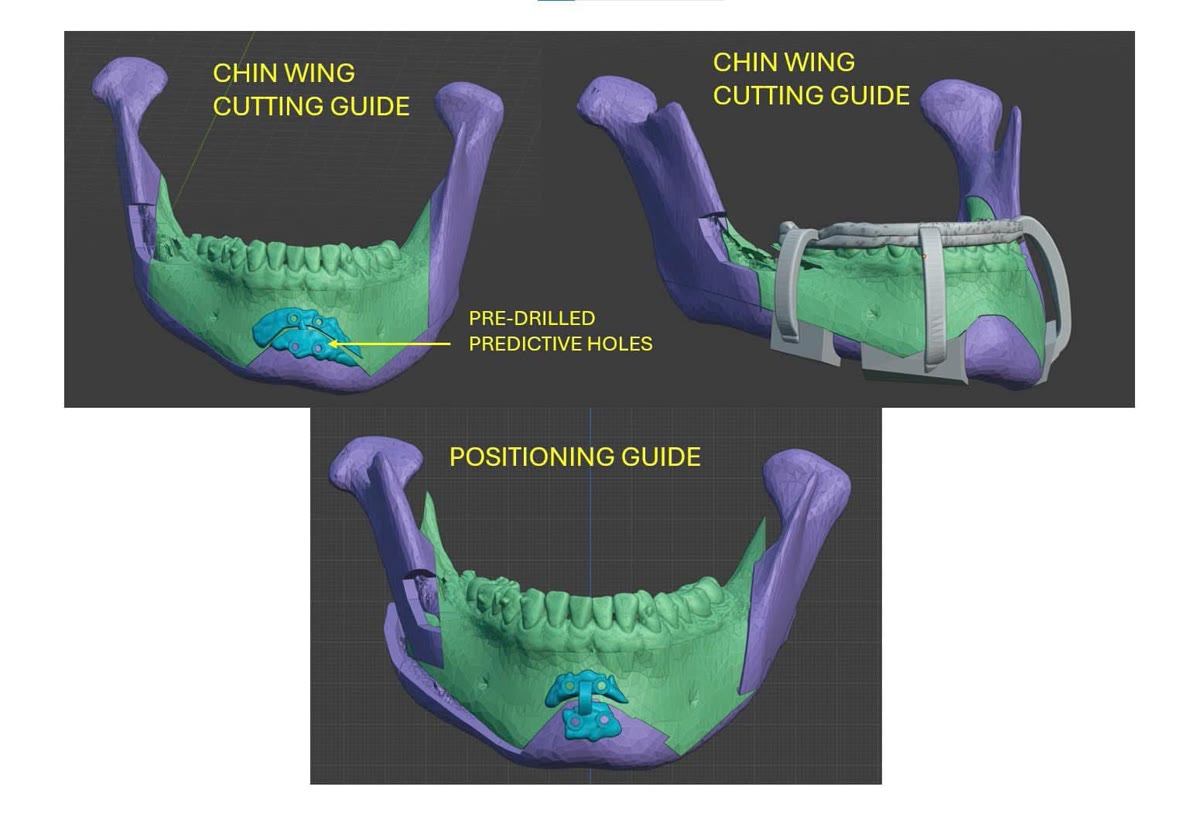
Máng hướng dẫn cắt xương được sử dụng để chuyển đường cắt đã thiết kế vào phẫu trường, trong khi dụng cụ định vị xương cá nhân hóa hỗ trợ đưa phân đoạn Chin Wing đến vị trí đã xác định trước.
Việc lập kế hoạch này đặc biệt có giá trị ở những trường hợp bất đối xứng, bởi hai bên xương hàm không thể đơn giản được xử lý bằng cùng một chuyển động đối xứng.
Từ kinh nghiệm đào tạo đến ứng dụng lâm sàng
Mình có cơ hội được học kỹ thuật Chin Wing từ Giáo sư Gwen Swennen trong thời gian đào tạo tại Bỉ.
Trong quá trình đó, mình và bác sĩ Gianluca Renato de Fazio cũng có cơ hội tham gia thiết kế máng hướng dẫn phẫu thuật cho các trường hợp Chin Wing do Giáo sư Swennen thực hiện.
Những kinh nghiệm này sau đó được mình áp dụng vào thực hành lâm sàng tại Việt Nam. Đến thời điểm thực hiện trường hợp này, kỹ thuật đã được áp dụng cho khoảng mười bệnh nhân với các dạng biến dạng tầng mặt dưới khác nhau.
Khớp cắn cân đối chưa chắc tạo ra một đường viền khuôn mặt cân đối
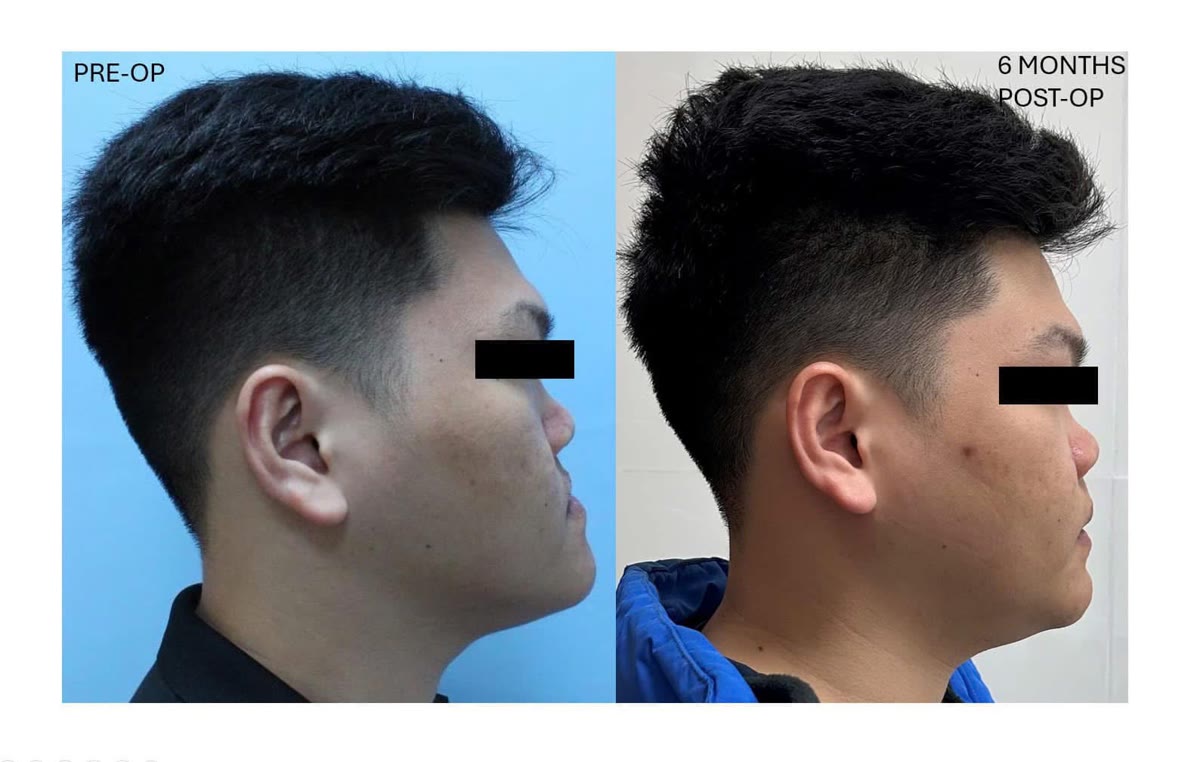
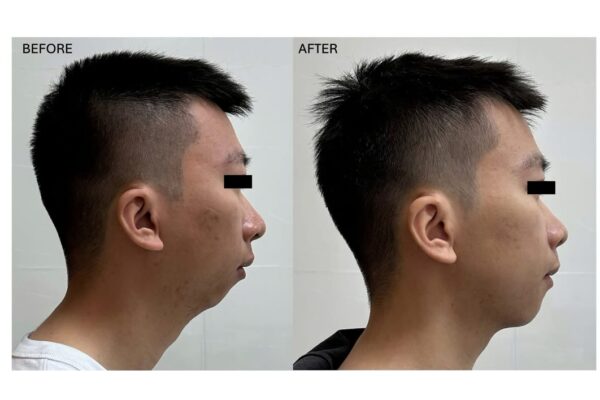
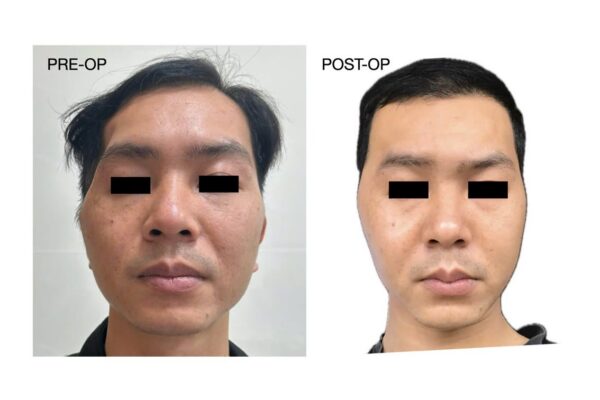
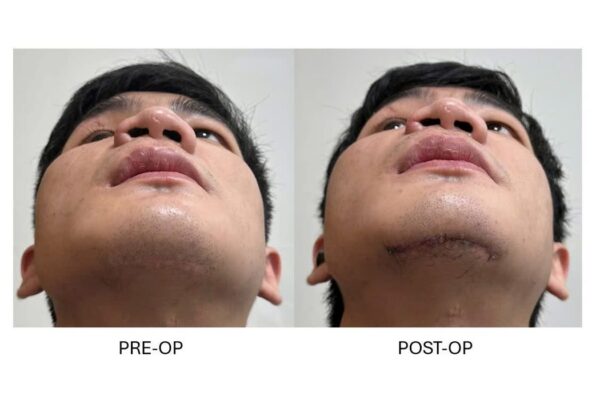
Sau sáu tháng, bệnh nhân đạt được sự cải thiện rõ rệt cả về tương quan hai hàm và sự cân đối của tầng mặt dưới.
Giá trị của Chin Wing trong những trường hợp được lựa chọn phù hợp nằm ở khả năng giải quyết một vấn đề mà phẫu thuật chỉnh hình xương hàm thông thường đôi khi không thể xử lý hoàn toàn:
vị trí của cung răng và hình dạng của bờ xương hàm dưới không nhất thiết phải thay đổi cùng nhau.
Khi tách hai yếu tố này thành những mục tiêu điều trị riêng biệt, chúng ta có thể đồng thời hướng tới một khớp cắn phù hợp và một đường viền xương hàm cân đối hơn.
Đối với những trường hợp bất đối xứng phức tạp, mục tiêu cuối cùng vì vậy không chỉ là đưa hai hàm về đúng vị trí, mà còn là kiểm soát hình dạng ba chiều của toàn bộ tầng mặt dưới.
In orthognathic surgery, achieving the correct relationship between the dental arches does not necessarily produce a symmetrical lower facial contour.
This becomes particularly relevant when the inferior border of the mandible is geometrically discordant with the orientation of the dental arch. Even after the maxilla and mandible have been repositioned into an appropriate skeletal and occlusal relationship, substantial asymmetry of the mandibular border and chin may remain.
Chin Wing osteotomy provides a means of addressing this component of the deformity independently.
When occlusion and mandibular contour represent different problems
Conventional orthognathic procedures such as Le Fort I osteotomy and bilateral sagittal split osteotomy (BSSO) primarily reposition the maxilla and mandible to correct skeletal relationships, occlusion, and facial balance.
Conventional genioplasty can independently modify the position and morphology of the chin.
Between the chin and the mandibular angle, however, lies another important aesthetic structure: the entire inferior border of the mandibular body.
In patients with complex facial asymmetry, the deformity may involve not only mandibular position but also the shape, height, and curvature of the lower mandibular border on each side.
The Chin Wing technique creates an extended inferior mandibular segment running from the chin toward the angle. Once mobilized, this segment can be repositioned relatively independently of the tooth-bearing portion of the mandible.
This allows the surgeon to control the chin–jawline–angle contour as a separate aesthetic unit, while the dental arches and skeletal occlusion are managed through conventional orthognathic movements.
Complex mandibular asymmetry with skeletal Class III malocclusion
In this patient, the two sides of the mandible differed in shape, position, and dimensions.
In addition to the asymmetry, significant mandibular overdevelopment resulted in a severe skeletal Class III relationship.
The maxillary arch also demonstrated transverse and morphological discrepancies that required correction.
If treatment had been limited to Le Fort I osteotomy and BSSO, the dental arches could have been repositioned into an appropriate relationship, but substantial asymmetry of the inferior mandibular border would have remained.
In other words, the occlusion could be corrected without fully correcting the lower facial contour.
This was the rationale for incorporating a Chin Wing osteotomy into the surgical plan.
Three components of the deformity, three complementary surgical strategies
The treatment plan incorporated three principal components.
A Chin Wing osteotomy was performed to independently modify the inferior mandibular border, improve symmetry between the two sides, and reconstruct the contour of the lower face.
A bilateral sagittal split osteotomy was performed to set the mandible back and correct the underlying mandibular excess and skeletal Class III relationship.
In the maxilla, a two-piece Le Fort I osteotomy was performed. This allowed maxillary advancement together with correction of the transverse and arch-form discrepancy, while controlling the occlusal plane and minimizing postoperative transverse malocclusion.
Each procedure therefore addressed a different component of the deformity:
Segmental Le Fort I osteotomy addressed the maxilla and dental arch.
BSSO addressed mandibular position and the maxillomandibular relationship.
Chin Wing osteotomy addressed the inferior mandibular border and lower facial contour.
Three-dimensional planning for Chin Wing osteotomy
Chin Wing osteotomy requires precise control of the osteotomy design.
The osteotomy extends along the mandibular body in close anatomical relationship to the inferior alveolar neurovascular canal, dental roots, and inferior mandibular border. Furthermore, the final position and morphology of the mobilized segment directly determine the postoperative jawline.
For this patient, both the osteotomy design and the intended position of the Chin Wing segment were therefore planned preoperatively in a three-dimensional virtual environment.
A patient-specific cutting guide was used to transfer the planned osteotomy to the surgical field, while a patient-specific positioning guide assisted in reproducing the intended final position of the mobilized segment.
This approach is particularly useful in facial asymmetry, where the two sides of the mandible cannot simply be treated with identical symmetrical movements.
From surgical training to clinical application
I had the opportunity to learn the Chin Wing technique from Professor Gwen Swennen during my surgical training in Belgium.
During this period, Dr. Gianluca Renato de Fazio and I also had the opportunity to participate in designing surgical guides for Chin Wing procedures performed by Professor Swennen.
I subsequently incorporated this experience into my clinical practice in Vietnam. By the time of this case, I had applied the technique in approximately ten patients presenting with different patterns of lower facial deformity.
Correct occlusion does not necessarily create a symmetrical jawline
At six months after surgery, the patient demonstrated substantial improvement in both the maxillomandibular relationship and lower facial symmetry.
The particular value of Chin Wing osteotomy in appropriately selected patients lies in its ability to address a problem that conventional orthognathic movements may not completely resolve:
the position of the dental arch and the contour of the inferior mandibular border do not necessarily need to move together.
By treating these as separate components of the deformity, it becomes possible to pursue both an appropriate occlusion and a more harmonious mandibular contour.
In complex facial asymmetry, the ultimate objective therefore extends beyond positioning the jaws correctly. It involves controlling the three-dimensional morphology of the entire lower face.